
I am a great fan of Richard Feynman & his simple yet insightful anecdotes. One of his quote about problem solving goes like this, “No problem is too small or too trivial if we can really do something about it.”
In the world full of cyclic glorification of certain disciplines & disdain of others, it gives one a sense of purpose and motivation to continue solving problems that inner curiosity demands attention to. They may or may not capture the imagination of the world but one must dive deep enough to seek the adventure of finding things out.
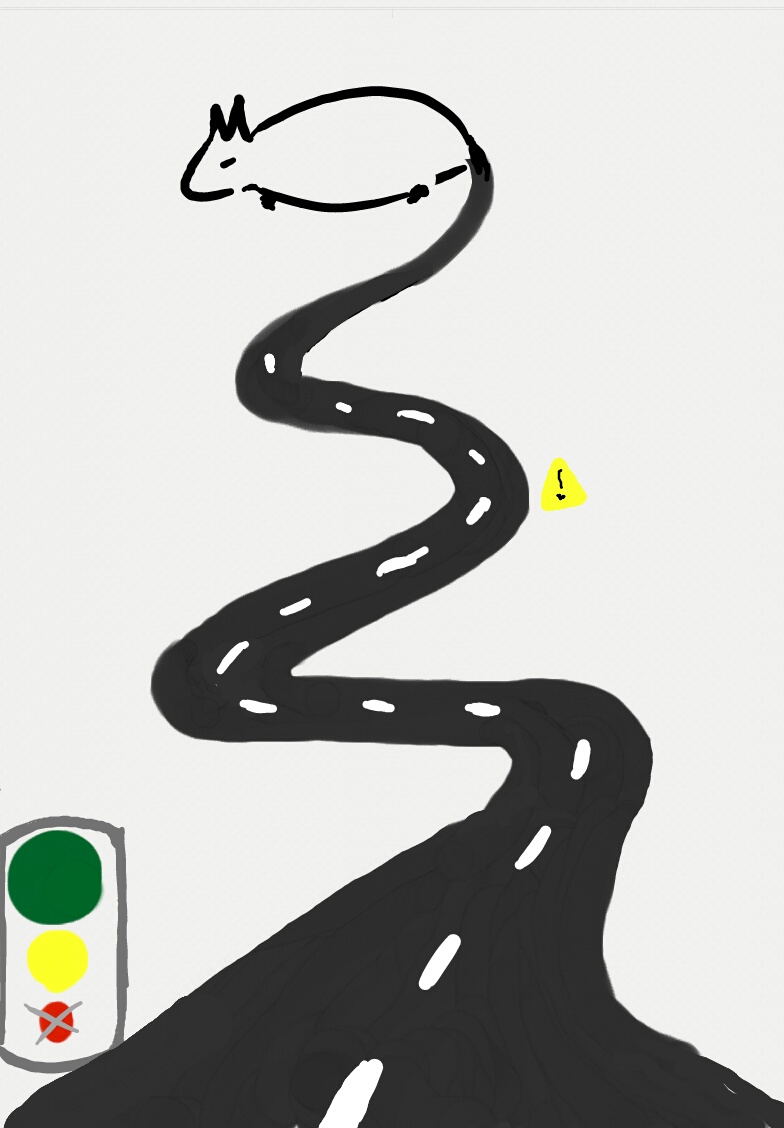
In a normal race (depicted in the sketch), how does one pick what to do, what not to do. There is so much glorification or disdain for certain areas, constant peer pressure of being on the right track and fear of losing out, that one becomes reactive rather than proactive. One tends to get engulfed into a chain reaction where, problems pick you and not the other way round. There is only finite time and energy and not all those problems are worth solving and many end up killing the curiosity, desire to learn. This is my first iteration of how one can approach it.
Any problem can be split into two main categories,
Mandatory:
When there is no choice. (Hardly 1% of the situations we face)
It is a matter of survival or critical importance to your personal values. Try not to make it an open ended situation. Evaluate full, partial success ciriterias and minimum required outcome. It is important not to get tangled into a maze of endless loops. Know when it’s done & move on.
Optional: When there is a choice. (99% of the situations we face)
- Apply Objective Filter -> Driven by Logic, Rationality, Facts.
- Apply Subjective Filter -> Stakeholders, Human psychology, Irrationality, Perceptions.
- Overlap both filters O+S -> Presents a real world problem or an opportunity.
- Define expected outcome -> Tangible results / Intangible results with best and the worst case scenarios. One guaranteed outcome from everything you do, is an opportunity to learn. So do account for that as it forms the foundation on which this model is reiterated and refined further.
- Finally make a decision to invest time and/or money, solve it yourself, delegate it to someone or skip altogether.
- Refine model & Go back to #1
P.S. – This post emanates from a book on the life of Charlie Munger that I recently read, (‘Poor Charlie’s Almanac’) where he extensively talks about something called ‘Mental Models’. His approach to multidisciplinary learning and connecting the dots across wide areas of interest, is quite fascinating & I think this post could just be one of the many I would write on that subject, as I learn, experience for myself the theory and various analogies.
 Devendra.blog